MY Facebook Group Facebook Twitter Google Plus Youtube Torrent Linkedin Pinterest
Showing posts with label Video Courses. Show all posts
thumbnail

Mobile Repairing Urdu Video Course Free Download

Posted by Sonu Mirza Leo  | 7 comments

Assalam o Alaikum(السلام و علیکم):

Friends............
You can Download "Mobile Repairing Urdu Video Course" from Here.

Related Post:

Click Here To Download Video Courses

About This:

A mobile phone (also known as a cellular phone, cell phone, and a hand phone) is a device that can make and receive telephone calls over a radio link while moving around a wide geographic area. It does so by connecting to a cellular network provided by a mobile phone operator, allowing access to the public telephone network. By contrast, a cordless telephone is used only within the short range of a single, private base station.
In addition to telephony, modern mobile phones also support a wide variety of other services such as text messaging, MMS, email, Internet access, short-range wireless communications (infrared, Bluetooth), business applications, gaming and photography. Mobile phones that offer these and more general computing capabilities are referred to as smartphones.
The first hand-held mobile phone was demonstrated by John F. Mitchell and Dr Martin Cooper of Motorola in 1973, using a handset weighing around 2.2 pounds (1 kg). In 1983, the DynaTAC 8000x was the first to be commercially available. From 1990 to 2011, worldwide mobile phone subscriptions grew from 12.4 million to over 6 billion, penetrating about 87% of the global population and reaching the bottom of the economic pyramid.
History:
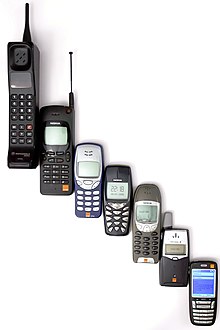
An evolution of mobile phones
The first mobile telephone calls were made from cars in 1946. Bell System's Mobile Telephone Service was made on 17 June in St. Louis, Missouri, followed by Illinois Bell Telephone Company's car radiotelephone service in Chicago on 2 October. The MTA phones were composed of vacuum tubes and relays, and weighed over 80 pounds (36 kg). There were initially only 3 channels for all the users in the metropolitan area, increasing later to 32 channels across 3 bands. This service continued into the 1980s in large portions of North America. Due to the small number of radio frequencies available, the service quickly reached capacity. In 1956, the world’s first partly automatic car phone system, Mobile System A (MTA), was introduced in Sweden.
John F. Mitchell, Motorola's chief of portable communication products in 1973, played a key role in advancing the development of handheld mobile telephone equipment. Mitchell successfully pushed Motorola to develop wireless communication products that would be small enough to use anywhere and participated in the design of the cellular phone. Martin Cooper, a Motorola researcher and executive, was the key researcher on Mitchell's team that developed the first hand-held mobile telephone for use on a cellular network. Using a somewhat heavy portable handset, Cooper made the first call on a handheld mobile phone on 3 April 1973 to his rival, Dr. Joel S. Engel of Bell Labs.
As I walked down the street while talking on the phone, sophisticated New Yorkers gaped at the sight of someone actually moving around while making a phone call. Remember that in 1973, there weren't cordless telephones or cellular phones. I made numerous calls, including one where I crossed the street while talking to a New York radio reporter - probably one of the more dangerous things I have ever done in my life.
—Martin Cooper,
The new invention sold for $3,995 and weighed two pounds, leading to the nickname "the brick".
The world's first commercial automated cellular network was launched in Japan by NTT in 1979, initially in the metropolitan area of Tokyo. In 1981, this was followed by the simultaneous launch of the Nordic Mobile Telephone (NMT) system in Denmark, Finland, Norway and Sweden. Several countries then followed in the early to mid-1980s including the UK, Mexico and Canada.
On 6 March 1983, the DynaTAc mobile phone launched on the first US 1G network by Ameritech. It cost $100m to develop, and took over a decade to hit the market. The phone had a talk time of just half an hour and took ten hours to charge. Consumer demand was strong despite the battery life, weight, and low talk time, and waiting lists were in the thousands.
In 1991, the second generation (2G) cellular technology was launched in Finland by Radiolinja on the GSM standard, which sparked competition in the sector as the new operators challenged the incumbent 1G network operators.
Ten years later, in 2001, the third generation (3G) was launched in Japan by NTT DoCoMo on the WCDMA standard. This was followed by 3.5G, 3G+ or turbo 3G enhancements based on the high-speed packet access (HSPA) family, allowing UMTS networks to have higher data transfer speeds and capacity.
By 2009, it had become clear that, at some point, 3G networks would be overwhelmed by the growth of bandwidth-intensive applications like streaming media. Consequently, the industry began looking to data-optimized 4th-generation technologies, with the promise of speed improvements up to 10-fold over existing 3G technologies. The first two commercially available technologies billed as 4G were the WiMAX standard (offered in the U.S. by Sprint) and the LTE standard, first offered in Scandinavia by TeliaSonera.
Search Options:
Learn Mobile Repairing course
How to Repair a Mobile
Mobile Repairing video course in urdu free Download
Mobile Repairing video Course free Download
Mobile Repairing in urdu free Download
Features:

A printed circuit board inside a Nokia 3210
All mobile phones have a number of features in common, but manufacturers also try to differentiate their own products by implementing additional functions to make them more attractive to consumers. This has led to great innovation in mobile phone development over the past 20 years.
The common components found on all phones are:
  • A battery, providing the power source for the phone functions.
  • An input mechanism to allow the user to interact with the phone. The most common input mechanism is a keypad, but touch screens are also found in some high-end smartphones.
  • Basic mobile phone services to allow users to make calls and send text messages.
  • All GSM phones use a SIM card to allow an account to be swapped among devices. Some CDMA devices also have a similar card called a R-UIM.
  • Individual GSM, WCDMA, iDEN and some satellite phone devices are uniquely identified by an International Mobile Equipment Identity (IMEI) number.
Low-end mobile phones are often referred to as feature phones, and offer basic telephony. Handsets with more advanced computing ability through the use of native software applications became known as smartphones.
Several phone series have been introduced to address a given market segment, such as the RIM BlackBerry focusing on enterprise/corporate customer email needs; the SonyEricsson Walkman series of musicphones and Cybershot series of cameraphones; the Nokia Nseries of multimedia phones, the Palm Pre the HTC Dream and the Apple iPhone.
SIM card:
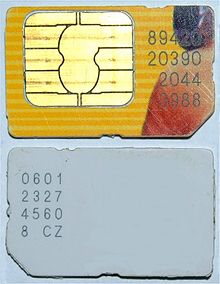
Typical mobile phone SIM card
GSM feature phones require a small microchip called a Subscriber Identity Module or SIM Card, to function. The SIM card is approximately the size of a small postage stamp and is usually placed underneath the battery in the rear of the unit. The SIM securely stores the service-subscriber key (IMSI) and the Ki used to identify and authenticate the user of the mobile phone. The SIM card allows users to change phones by simply removing the SIM card from one mobile phone and inserting it into another mobile phone or broadband telephony device.
The first SIM card was made in 1991 by Munich smart card maker Giesecke & Devrient for the Finnish wireless network operator Radiolinja.

Trailer:


Download Information:

Click Here to Download Via Torrent.

This is the Compressed File.You just download and unzip with any of these softwares.

Download Power Zip

Download Winrar

Download 7 ZIP 

Download Winzip

Download Both Parts....

Read More»

thumbnail

Computer Hardware Urdu Video Course Free Download

Posted by Sonu Mirza Leo  | 2 comments

Assalam o Alaikum(السلام و علیکم):

Friends............
You can Download "Computer Hardware Urdu Video Course" from Here.

About This:

Computer hardware equals the collection of physical elements that constitute a computer system. Computer hardware refers to the physical parts or components of a computer such as monitor, keyboard, Computer data storage, hard drive disk, mouse, printers, CPU (graphic cards, sound cards, memory, motherboard and chips), etc all of which are physical objects that you can actually touch. In contrast, software is untouchable. Software exists as ideas, application, concepts, and symbols, but it has no substance. A combination of hardware and software forms a usable computing system.

Trailer:


Download Information:


Click Here to Download Via Torrent.

This is the Compressed File.You just download and unzip with any of these softwares.

Download Power Zip

Download Winrar

Download 7 ZIP 

Download Winzip

To Download Click Down.

Read More»

thumbnail

English Guru Books and Video Course Free Download

Posted by Sonu Mirza Leo  | 5 comments

Assalam o Alaikum(السلام و علیکم):

Friends............
You can Download "English Guru Complete Video Course With English Guru Books (Get,Set & Go)" from Here.

About This:

About English:
English is a West Germanic language that was first spoken in early medieval England and is now the most widely used language in the world. It is spoken as a first language by the majority populations of several sovereign states, including the United Kingdom, the United States, Canada, Australia, Ireland, New Zealand and a number of Caribbean nations. It is the third-most-common native language in the world, after Mandarin Chinese and Spanish. It is widely learned as a second language and is an official language of the European Union, many Commonwealth countries and the United Nations, as well as in many world organisations.
English arose in the Anglo-Saxon kingdoms of England and what is now southeast Scotland. Following the extensive influence of Great Britain and the United Kingdom from the 17th century to the mid-20th century, through the British Empire, and also of the United States since the mid-20th century, it has been widely propagated around the world, becoming the leading language of international discourse and the lingua franca in many regions.
Historically, English originated from the fusion of closely related dialects, now collectively termed Old English, which were brought to the eastern coast of Great Britain by Germanic settlers (Anglo-Saxons) by the 5th century – with the word English being derived from the name of the Angles, and ultimately from their ancestral region of Angeln (in what is now Schleswig-Holstein). A significant number of English words are constructed on the basis of roots from Latin, because Latin in some form was the lingua franca of the Christian Church and of European intellectual life. The language was further influenced by the Old Norse language because of Viking invasions in the 9th and 10th centuries.
The Norman conquest of England in the 11th century gave rise to heavy borrowings from Norman French, and vocabulary and spelling conventions began to give the appearance of a close relationship with Romance languages to what had then become Middle English. The Great Vowel Shift that began in the south of England in the 15th century is one of the historical events that mark the emergence of Modern English from Middle English.
Owing to the assimilation of words from many other languages throughout history, modern English contains a very large vocabulary, with complex and irregular spelling, particularly of vowels. Modern English has not only assimilated words from other European languages, but from all over the world. The Oxford English Dictionary lists over 250,000 distinct words, not including many technical, scientific, and slang terms.
Search Options:
English Guru Books free Download
English Guru Books in PDF free Download
English Guru Video Course free Download
English Guru Videos free Download
English Guru Books Get,Set & Go free Download
English Guru Books Get,Set & Go in Urdu free Download
English Guru Videos Get,Set & Go free Download
It has three parts Get,Set & Go.
English is undoubtedly a language of repute and growth in modern age. It is also known as a gateway to world treasures. Progress and development is almost impossible without the knowledge of English. If we talk about English in Indian context, knowledge of English language is not imparted to the students at an early age. As a result, they face a number of problems in their career when they grow up. It is in the light of this statement that a team of English language trainers decided to develop a website devoted to weak and poor students, who can not afford the high fees of English language training centres. The site focuses on the overall development of language skills i.e. listening, speaking, reading and writing.

Website: http://www.myenglishguru.com/

Video Trailer:


Download Information:

This is the Compressed File.You just download and unzip with any of these softwares.

Download Power Zip

Download Winrar

Download 7 ZIP 

Download Winzip

To Download Click Down.

Read More»

© 2013 Sonu Mirza Leo. WP Sonu Mirza Leo converted by ITMASTI.COM
Asad Mirza. Powered by Blogger.
back to top